When Should You Switch Supplier?
Learn why timing still matters and how the right moment to act can affect cost.
Read article →Energy prices have stabilised compared to the extreme volatility of recent years, but that doesn’t mean businesses are now getting good value. In many cases, costs remain elevated, and businesses still need to manage their energy position proactively.
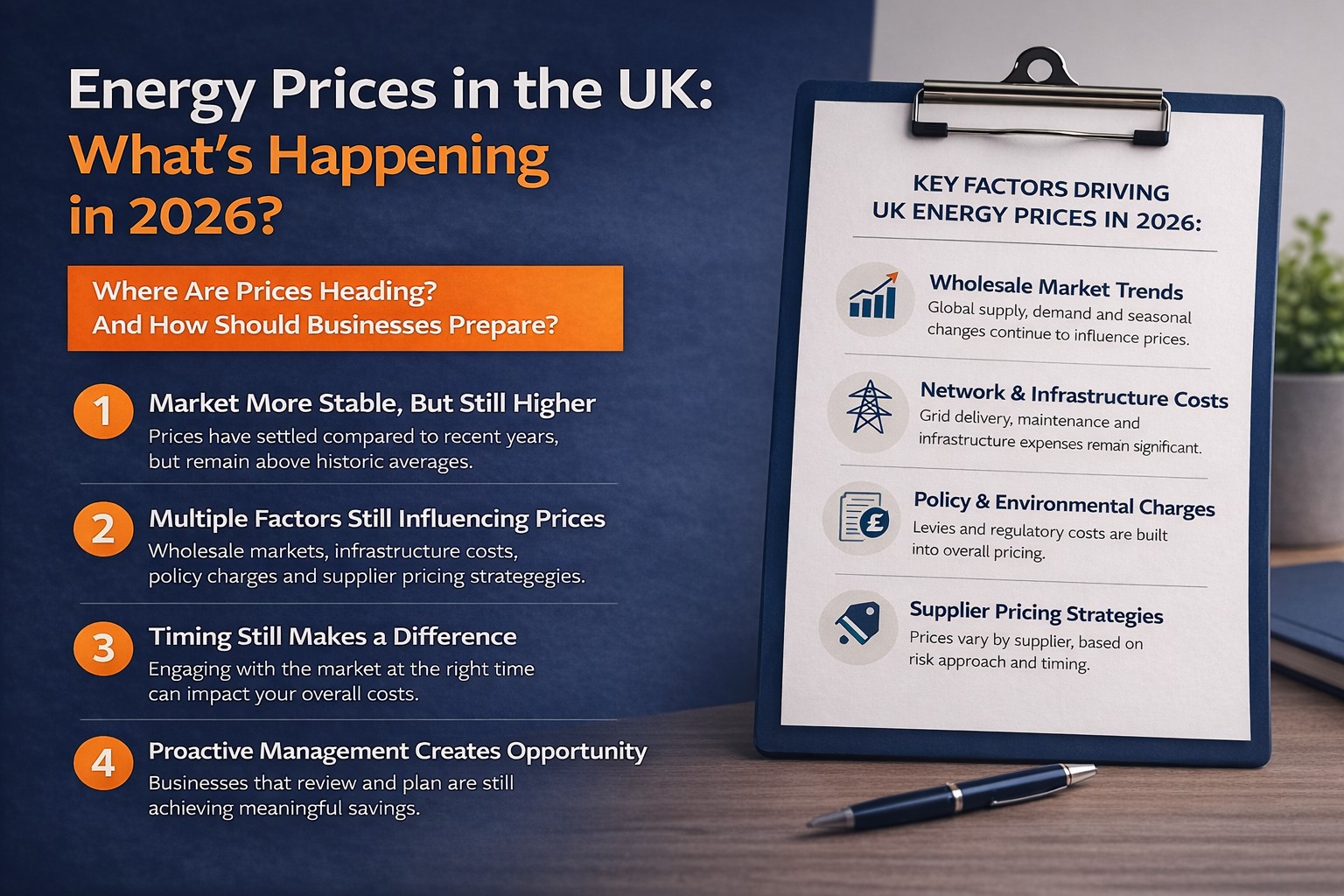
Compared to the sharp spikes seen previously, the market has become more stable. But stability doesn’t automatically mean affordability.
Many businesses are still facing:
Several core factors continue to influence what businesses pay in 2026:
Even when wholesale prices ease, businesses don’t always see the full benefit immediately because the total price includes much more than just the wholesale element.
A quick review of your current agreement can show whether your rates still make sense in the current market.
Understand My Costs →In 2026, many businesses are not overpaying because the market is in crisis. They’re overpaying because their contract has not kept pace with the market.
Common examples include:
That means the opportunity often isn’t in using less energy — it’s in reviewing what you’re being charged for it.
One of the biggest mistakes businesses make is assuming that because the market is calmer, there is no need to review their contract.
In reality, timing still makes a significant difference:
The businesses that tend to perform best on energy are not always the ones with the biggest consumption. They’re the ones that:
In 2026, the opportunity is still there — but it needs to be managed, not left to chance.
The market may be more stable, but energy is still not something to ignore.
If your contract hasn’t been reviewed in some time, there’s a strong chance you’re paying more than you need to — even in a calmer market.
Grid Hop can help you understand how your current rates compare to the market and whether there’s an opportunity to improve your position.
Get My Free Energy Review →